An Overview of Bridge Landscape Lighting
Table of Contents
Introduction
With the sustained growth of the national economy, urban construction and transportation infrastructure have entered a period of rapid development. As the saying goes, “Build roads through mountains and bridges over rivers,” various bridge projects have sprung up like bamboo shoots after a spring rain. These bridges have not only become transportation arteries connecting regions but are increasingly serving as important symbols of a city’s image. In this process, bridge lighting has undergone a profound transformation from simply “illuminating” to “enhancing beauty”—initially, the demand for bridge lighting was limited to meeting basic safety requirements for nighttime traffic; today, bridge lighting has been imbued with richer significance: it must not only ensure traffic safety and achieve aesthetic enhancement at night but also balance energy conservation, environmental protection, and sustainable operation and maintenance.
This transformation is not accidental but rather an inevitable requirement as urbanization enters a phase of refined development. As an integral part of the city’s skeletal structure, a bridge’s nighttime appearance directly influences perceptions of urban quality. For this reason, bridge landscape lighting has evolved from a supplementary project to a key specialized design element in bridge construction and renovation, warranting systematic examination by lighting professionals at the conceptual, technical, and practical levels.

Safety First
Bridges are, by their very nature, transportation facilities, and their primary function is to provide safe and efficient passage for vehicles and pedestrians. Therefore, no matter how impressive the landscape lighting may be, it must be implemented in strict compliance with traffic lighting regulations.
First, bridge landscape lighting must not interfere with traffic signal lighting systems. This means that the choice of light color and the placement of fixtures for decorative lighting must be sufficiently distinct from traffic signals, signs, and navigation lights to prevent misjudgment by drivers or crew members. Particularly on bridges spanning rivers, flashing lights should not be used near bridge pier lights or around bridge and culvert markers to avoid confusion with navigation signals.
Second, glare control is a key challenge in bridge landscape lighting design. Bridges are often located over open water or on urban elevated structures; their lighting not only affects vehicles traveling on the bridge but may also cause glare interference for drivers on adjacent roads and pilots of vessels navigating beneath the bridge. According to relevant standards, the maximum initial value of the glare limit threshold increment (TI) on expressways and arterial roads should not exceed 10%, and on secondary roads, it should not exceed 15%. To this end, luminaires equipped with light shields or louvers should be installed when necessary to control the emitted light within the target illumination area through precise light distribution.
Furthermore, the continuity of functional bridge lighting warrants attention. The lighting on the bridge and the connecting road should maintain consistent color temperature and illuminance levels to ensure that drivers do not experience visual adaptation issues due to sudden changes in lighting at the bridge-road junction. When the bridge deck is narrower than the connecting road, vertical lighting should also be provided for guardrails and curbs to clearly mark the boundaries of the bridge deck and ensure traffic safety.

The Core Logic of Landscape Lighting
If meeting functional requirements is the “minimum standard” for bridge lighting, then highlighting the structural aesthetics of a bridge through the language of light is the core pursuit of landscape lighting design. Good bridge lighting does not simply “illuminate” the bridge indiscriminately; rather, it involves a deep understanding of the bridge’s structural logic and uses light and shadow to enhance the expression of its architectural language.
Bridge structures come in a wide variety of forms—arch bridges, cable-stayed bridges, suspension bridges, girder bridges, and rigid-frame bridges—each possessing its own unique mechanical beauty, and lighting techniques vary accordingly. For arch bridges, lighting should focus on highlighting the curved form of the main arch, showcasing its powerful presence and graceful curves; for cable-stayed bridges, floodlights can be installed at the base of each stay cable to project upward, creating a signature “curtain of light” effect, while also emphasizing the illumination of the pylons to shape their towering silhouette; for suspension bridges, the focus should be on accentuating the tower’s form to highlight its soaring and majestic presence.
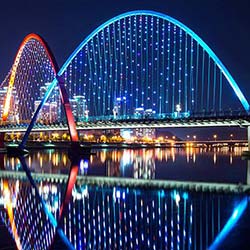
Take the recently internationally award-winning Nanjing Meiyuan South Road Bridge over the New Qinhuai River as an example: through a multi-layered lighting scheme—including smart color-changing floodlights on the inner and outer sides of the main arch, point lights at cable attachment points, and wall-washing lights on the bridge’s exterior—the project precisely outlines the grand contours and fluid lines of the arched steel framework. At the same time, it resonates with the cultural significance of the Buddha’s Summit Palace on Niushou Mountain, realizing the design philosophy of “a resonance between past and present, where scenery and light coexist.” This case clearly demonstrates that only through a deep understanding of a bridge’s structural characteristics and cultural context can lighting design truly become an extension of the architectural language, rather than merely an added ornament.

Key Implementation Principles
At the implementation level, bridge landscape lighting must also focus on the following three key points.
First, concealed installation of lighting fixtures. “See the light, not the fixture” is a widely accepted principle of high-quality landscape lighting. Fixtures and wiring should be pre-embedded or concealed as much as possible to avoid affecting the bridge’s overall appearance during the day. Particularly on bridges carrying heavy-duty vehicles, the installation of fixtures must also fully consider the stability of mounting brackets to prevent safety hazards caused by fixture misalignment or the falling of ancillary equipment due to bridge vibrations.
Second, moderate control of brightness and light color. When it comes to bridge lighting, brighter is not necessarily better, nor is a richer color palette always preferable. The light color should harmonize with the bridge’s design style and the surrounding environment to avoid visual confusion caused by excessive use of colored light. For bridges spanning rivers, the effect of reflections on the water’s surface must also be considered; these reflections should be fully utilized to enhance the completeness of the nighttime scenery, while taking care to avoid glare caused by the reflections.
Third, green, low-carbon, and smart operation and maintenance. With the advancement of the “dual carbon” goals, bridge lighting is rapidly upgrading to LED light sources and smart control systems. LEDs have become the mainstream choice due to their advantages of high energy efficiency, long service life, and rapid response. Furthermore, through smart lighting management platforms, it is possible to achieve individual lamp control, time-based dimming, and on-demand lighting—automatically reducing brightness during late-night hours when traffic is sparse, thereby achieving precise energy savings while ensuring safety standards are met. The green lighting retrofit projects on five bridges spanning the Yangtze River in Wuhan demonstrate that replacing traditional lighting fixtures with LEDs and integrating smart control systems not only significantly reduces energy consumption but also enhances operational and maintenance efficiency through real-time monitoring.

Conclusion
Bridge landscape lighting is a comprehensive design field that integrates functional safety, structural aesthetics, cultural expression, and technological application. It requires lighting engineers to have a solid foundation in traffic regulations, optical control, and electrical safety, as well as designers to possess a keen sensitivity to architectural language and urban culture. With technological advancements, intelligent, low-carbon, and refined approaches are becoming the new direction for bridge lighting development, while the personalized design philosophy of “one bridge, one strategy” is being validated in an increasing number of practical applications. For lighting professionals, understanding bridges, adhering to regulations, mastering technology, and paying attention to details are essential to delivering works in this specialized field that stand the test of both day and night.